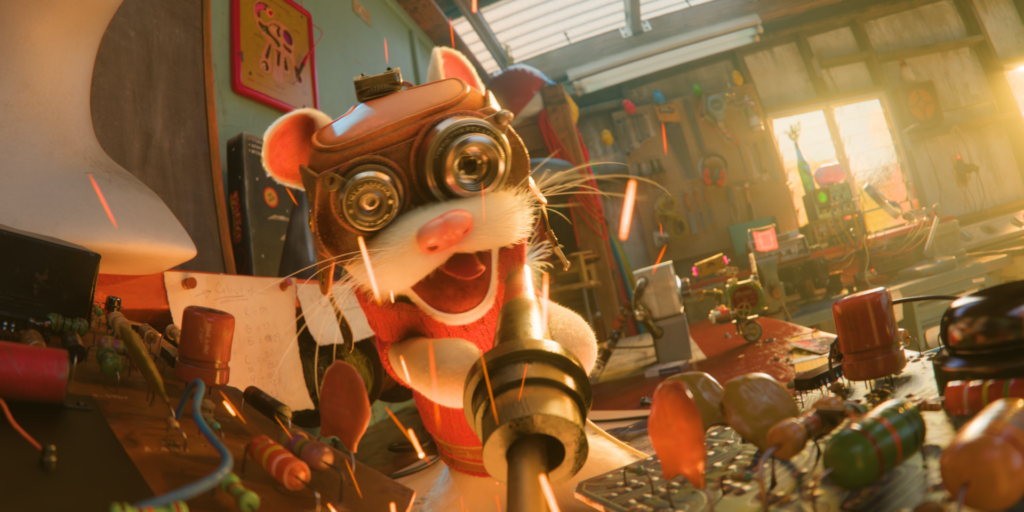
The Digital Production Example Library (DPEL) is an Academy Software Foundation hosted project curating production-grade sample content for hardware and software testing purposes. DPEL has steadily grown in recent years thanks to generous contributions, with assets including Netflix Animation Studios’ ALab production scene, Adobe’s OpenPBR Shader Playground asset, Amazon Web Services’ Airship asset, Intel’s Volumetric Cloud Library, the ASC’s StEM2 short film, and more. Recently, Netflix Animation Studios contributed the newest asset to DPEL: Sole Mates.
Created from an internal short film project, Sole Mates is a High Dynamic Range (HDR) production example, leveraging the ALab production scene and ACES 2.0. It includes data for a 61 frame shot, with 42 different lighting render layers covering environments, characters, and volume renders, which also contain Cryptomatte data. The Sole Mates package comes with a Nuke compositing script, rendered OpenEXR sequence, and both HDR and SDR videos.
The following smaller downloadable assets are also available:
- Sole Mates Single Frame Package – v.1.0.0: Single Frame Package is a lighter version of the complete package, hosted on GitHub. It includes a single frame from all lighting render layers and the OpenEXR sequence, and a Nuke script set up for that frame. It also contains the full range SDR and HDR videos.
- Lighting Render Layer (Beauty Set Only) – v.1.0.0: A single lighting render layer for the Beauty Set with full frame range and including the cryptomatte channels and manifests.
- OpenEXR Sequences – v.1.1.0: The OpenEXR Sequence is the final export of the package with 16-bit float precision. It is in ACES2065-1 (AP0) color space and intended to view with ACES 2.0 display transforms.
- QuickTime SDR + HDR Media – v.1.0.0: HDR and SDR videos (HDR – 2:1 @2k, 1000nits ProRes4444XQ, Rec2020, ACES 2.0, 2048×1024) (SDR – 2:1 @ 2k, 100nits ProRes422HQ, Rec709, ACES 2.0, 2048×1024)
DPEL grew out of the industry’s long-standing need for production-grade sample content in order to thoroughly test hardware and software in development and ensure that it can scale to the demands of the film and TV content creation process. Such content is normally locked inside each studio, with legal, copyright, and policy barriers that make it difficult to distribute to developers, researchers, and educators. By providing a vendor-neutral platform and a uniform license agreement, DPEL makes it easier for studios to contribute content that will be of value to the broader community.
To stay up to date with the DPEL project, find them on Slack at #assets, or join one of their Technical Steering Committee meetings on Zoom.