The Academy Software Foundation, the motion picture industry’s premier organization for advancing open source software development, today welcomed its newest project: OpenPGL, short for Open Path Guiding Library. Initially developed by Intel, OpenPGL allows artists and developers to use more realistic lighting when building and designing their scenes and animations, while still offering artistic freedom at the same or better rendering performance.
Path guiding is an important sampling strategy that improves rendering efficiency by incorporating additional information about a scene’s light distribution into the importance sampling process (e.g., directions, distances, or scattering decisions). While various academic research works on path guiding exist, reimplementing and integrating them into a production system can often be tedious. OpenPGL provides a production-ready, open source library enabling developers to easily integrate state-of-the-art path guiding methods into their professional or scientific renderers. The goal of OpenPGL is to provide implementations that are well-tested and robust enough for use in a production environment.
“As an ASWF project, the professional rendering community will have the opportunity to participate in OpenPGL’s future development and push the limits of rendering even further,” said Sebastian Herholz, OpenPGL Maintainer and Senior Developer and Researcher at Blender. “In addition, it will provide rendering researchers with a platform to experiment with new path guiding ideas and lower the barriers to test them in production contexts.”
OpenPGL can be integrated into any path tracing-based renderer for interactive and final-frame rendering. Its API decouples the integration of path guiding into a rendering system from the nitty-gritty details of implementing the underlying guiding structures and training algorithms. This enables developers to easily integrate state-of-the-art path guiding algorithms, tested across a wide variety of production-related light-transport scenarios. OpenPGL has already been adopted and integrated into leading renderers, including Blender’s Cycles, Chaos’ V-Ray, SideFX’s Karma, Disney Animation’s Hyperion, and others.
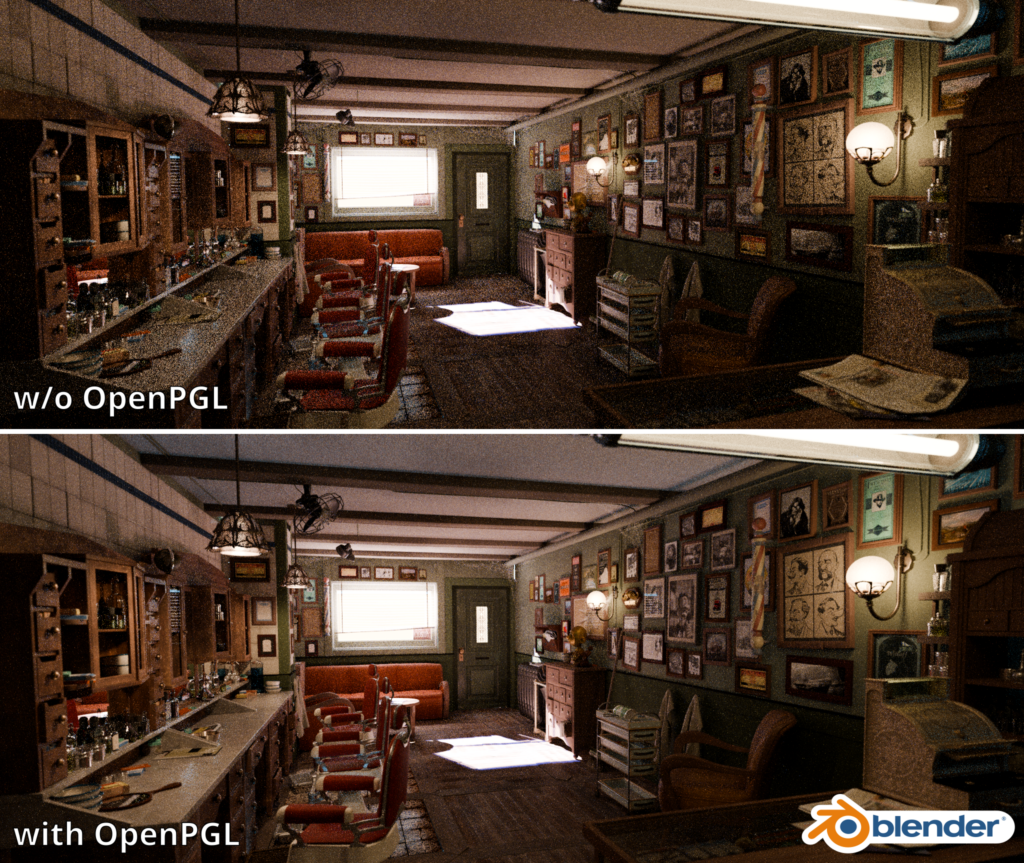
Renderings of the barbershop scene by Blender Studio (physically lit version), using the Cycles render with path guiding off (top) and on (bottom).
Studio support for OpenPGL:
“OpenPGL is an important building block in the second generation path guiding system of Walt Disney Animation Studios’ Hyperion renderer. OpenPGL provides a rich set of tools and a simple API, allowing us to simplify our implementation and iterate rapidly to solve production challenges. Our new path guiding system using OpenPGL proved to be an invaluable tool in the production of Zootopia 2. Path guiding was used in Zootopia 2, including on many of the film’s most technically challenging shots with difficult lighting setups and complex volumetrics. We are excited to see where OpenPGL goes next, with continued contributions from the open source community under the governance of the Academy Software Foundation.” – joint statement from Walt Disney Animation Studios and DisneyResearch|Studios
“At Illumination Studio Paris, OpenPGL has enabled us to bring advanced path guiding techniques into our production renderer in a robust and practical way. It helps us manage complex lighting more efficiently, reduces the need for labor-intensive hacks, and gives artists more freedom to work with natural lighting setups. The library proved especially valuable on our latest production, The Super Mario Galaxy Movie, where it helped us tackle challenging lighting scenarios more effectively. We’re genuinely excited to see OpenPGL join the Academy Software Foundation, as it gives the project a strong future and reflects its growing importance in production rendering.” – Thomas Metais, Lead R&D Engineer, Illumination Studios Paris
“OpenPGL brought impressive performance gains in various types of production scenes with complex lighting. Given the already existing multitude of optimizations in our code, this is no small feat! The integration into V-Ray is relatively straightforward. Sebastian has always been very helpful and responsive whenever we had problems or questions. We can’t wait to see what improvements come next!” – Dian Nikolov, Software Developer, Chaos
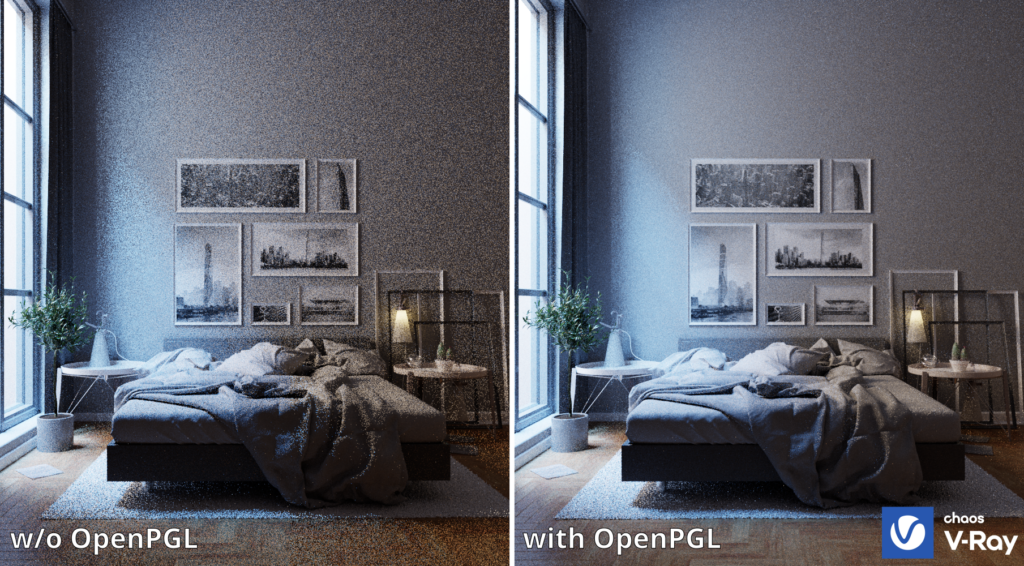
Render results provided by Chaos, showing path guiding off (left), and path guiding on (right).
OpenPGL will start out as a sandbox project within the Academy Software Foundation. The sandbox stage is the earliest entry point into the Foundation for young projects, to provide a framework and resources for continued development with the goal of graduating to the incubation stage within one year. OpenPGL’s continued development will be guided by a Technical Steering Committee, led by maintainer Sebastian Herholz.
Developers interested in learning more or contributing to OpenPGL can join their Slack channel here.
Companies interested in supporting the mission of the Academy Software Foundation can learn more and join at aswf.io/join.